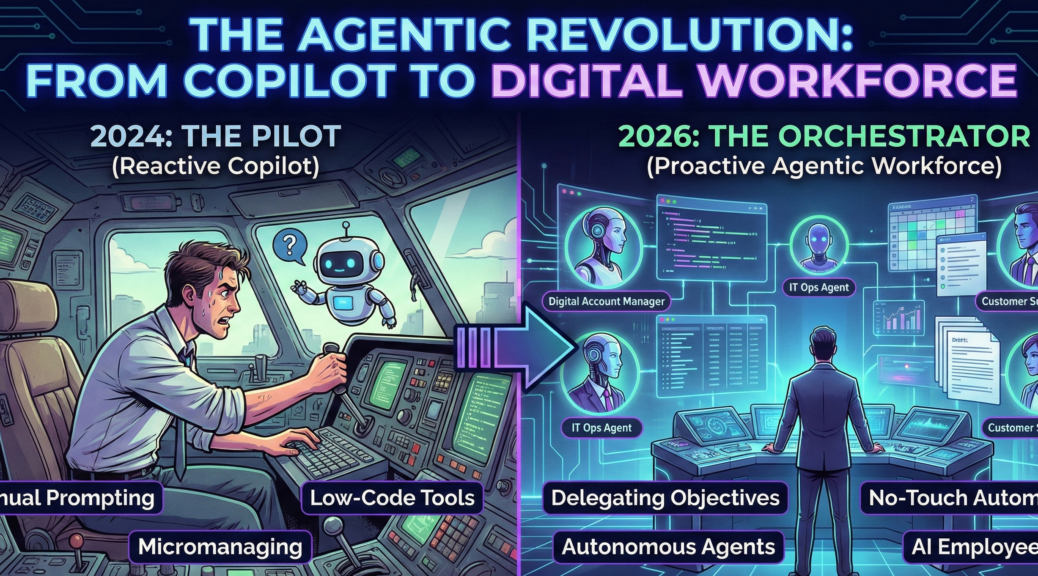
The Death of the Copilot: What comes now?

For the last two years, the tech world has been obsessed with the «Copilot.» We’ve been told that AI is our sidekick, our wingman, the Robin to our Batman. We learned the «art of the prompt,» carefully crafting instructions to get the outputs we needed. And Copilots have been added in almost every application form PowerPoint to Dynamics Customer Engagement
But let’s be honest for a minute being a pilot is exhausting compared to a beach vacation. If you are still the one sitting in the cockpit, manually steering every interaction, debugging every step, and babysitting the output, you aren’t really scaling. It’s more like you’re just micromanaging software.
In 2026 we see a shift as more people have started to use the basic AI. We are moving from Low-Code to No-Touch. It’s time to stop treating AI as a tool and start treating it as an employee. Welcome to the Agentic Revolution, where your AI gets its own email-address and profile picture.
From «Chatting» to «Delegating»
The difference between a «Copilot» and an «Agent» is the autonomy.
Until recently, AI was reactive. It waited for a trigger or a user input. But now agents are proactive. They use reasoning loops that allow them to break down a complex goal into a series of independent tasks.
- The Old Way (The Tool): You build a Power Automate flow to trigger a notification when a contract is expiring. Then you manually check the data and decide what to do with it.
- The New Way (The Employee): You give an Agent a high-level business objective like: «Increase contract renewal rates by 5%.» Now the Agent doesn’t wait for your next prompt. It runs through your CRM, identifies accounts at-risk, references past successful negotiation tactics we have used Then the agent drafts personalized renewal offers and only pings you when a human interaction is required. You didn’t build a flow its more like you hired a digital account manager.
The AI Orchestrator
You are not dragging and dropping boxes onto a canvas anymore. Instead you give instructions in natural language. This changes the DNA of the «Citizen Developer.» And in its place, a new role has emerged: the AI Orchestrator.
The Orchestrator doesn’t focus on the how; they focus on the what. Their skill set has shifted from technical logic to organizational leadership for machines. They are responsible for:
- Defining Guardrails: Setting the «Rules of Engagement» so agents stay within budget, brand voice, and compliance.
- Persona Engineering: Using Copilot Studio to give agents specific roles, deep knowledge bases, and the «authority» to take action.
- Outcome Auditing: Reviewing the results of the digital workforce rather than the syntax of the code.
Managing Your New Digital Team
Transitioning from writing prompts to managing agents requires a shift in mindset . Here are four tips that can help you lead your agentic workforce more effectivly:
1. Move from «Instructions» to «Objectives» Stop telling the AI how to do the task step-by-step. Instead, define what a «successful outcome» looks like. If the goal is clear, the agent can figure out the path.
2. Build «Knowledge Bridges,» Not Just Flows An agent is only as good as its context. Instead of just connecting a database, curate «Knowledge Sets». clean, high-quality documentation that the agent can use to make informed decisions. This can be your knowledge articles in Dynamics Customer Service. Which also can be keept up to date by humans and AI agents.
3. Treat Your Agents Like Interns When you first deploy an agent, give it low-stakes tasks. Audit its runs to see how it’s thinking. As it proves its reliability, promote it to higher-value workflows.
4. Implement «Human-in-the-Loop» Thresholds Even when step 3 have been completed, don’t automate blindly. Set «Confidence Thresholds.» For example, tell the agent: «If the deal value is over $50k or your confidence in the solution is below 80%, flag it for my manual review.» And use small thresholds until you gain confidence in your agent. You would not send you junior sales rep alone to land that 1 million deal.
The Future is No-Touch
The Power Platform is no longer just a place to build apps; it’s the «HR Department» for your digital labor. We’ve moved past the «Chatbot» phase and entered the era of Hyper-Automation, where the most valuable skill you can have isn’t knowing how to code, it’s knowing how to lead these new virtual collegues.
The transition from Pilot to Orchestrator is the most significant career pivot of the decade. Don’t get left in the cockpit while the rest of the world is running the airline.
The Agentic Audit: From Passive Flows to Autonomous Employees
Building on the shift from «Copilot» to «Employee,» it’s time to look at your current automation stack. Most businesses are sitting on a goldmine of «passive flows» that are begging to be promoted to «Autonomous Agents.»
The goal of this audit is to identify where you are still acting as the «pilot» and where you can finally step back and let the Agentic Workforce take over.
The Agentic Audit Checklist
Run your current Power Platform solutions through these four filters to see if they are ready for an upgrade.
1. The Trigger Test: Reactive vs. Proactive
- Current State: Does the automation only start when a human clicks a button or an email arrives?
- Agentic Upgrade: Can the AI monitor a goal or a metric (e.g., «Daily Sales Target») and initiate its own workflow if that metric isn’t being met?
- Action: Transition from Event-Based triggers to Goal-Based monitoring.
2. The Logic Test: «If/Then» vs. Reasoning
- Current State: Is your flow a giant «Switch» or «Condition» tree with 20 different branches?
- Agentic Upgrade: Can you replace those 20 branches with a single Generative Action in Copilot Studio that uses reasoning to decide the best path based on the context?
- Action: Swap complex nested conditions for Natural Language Instructions.
3. The Knowledge Test: Static Data vs. Living Context
- Current State: Does your flow just move data from Point A to Point B without «understanding» it?
- Agentic Upgrade: Does the process have access to your SharePoint, Wikis, and PDF manuals to make informed decisions about the data it’s moving?
- Action: Connect Knowledge Sources to your flows so the AI can «think» before it acts.
4. The Human-in-the-Loop (HITL) Test: Permission vs. Assistance
- Current State: Does the AI stop and wait for you to do the «hard part» (writing the email, analyzing the sentiment)?
- Agentic Upgrade: Does the AI do the work and simply present you with a «Approve/Reject» button or a final draft?
- Action: Re-engineer flows so the human is the Editor-in-Chief, not the lead writer.
High-Value Use Cases for 2026
If you’re looking for a place to start, these three areas are «low-hanging fruit» of the Agentic Revolution:
| Department | Old Way (Copilot/Flow) | New Way (Agentic Employee) |
| Customer Success | Notifies you of a negative survey. | Analyzes the survey, checks the client’s history, and drafts a recovery plan. |
| Sales | Reminds you to follow up on a lead. | Researches the lead’s LinkedIn, finds a relevant news hook, and sends the first touch. |
| IT/Ops | Alerts you that a server is down. | Investigates the logs, attempts a reboot, and summarizes the incident for your review. |
Your Next Step
The «Citizen Developer» of 2024 built apps. The AI Orchestrator of 2026 builds teams.
By running this audit you are identifying the «job descriptions» for your new digital workforce. Stop writing prompts; start writing roles.