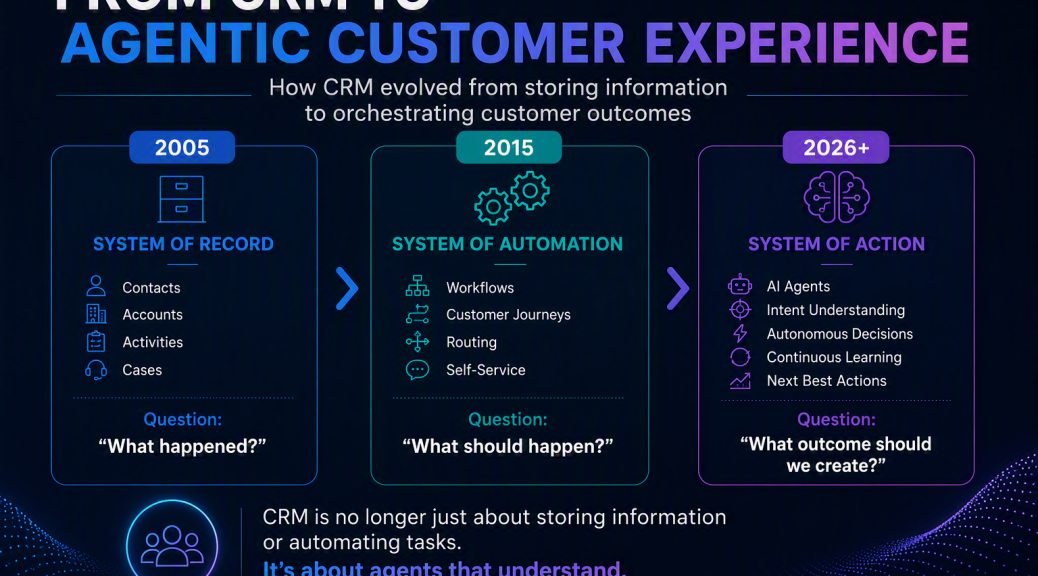
What Is Agentic Customer Experience?
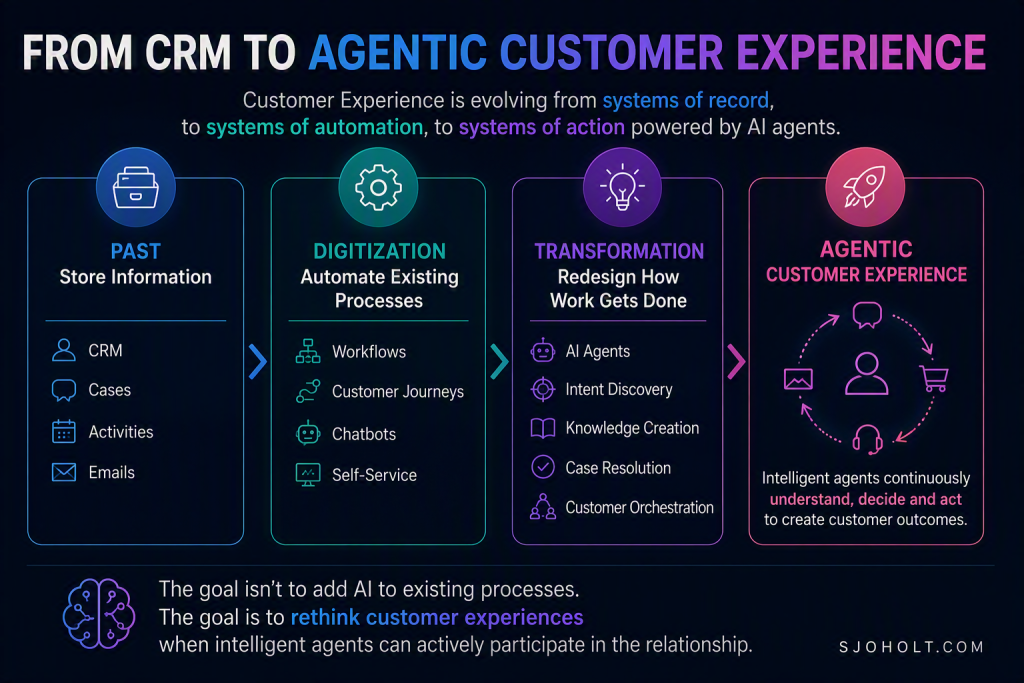
Most organizations haven’t transformed customer experience. They’ve simply digitized it. Moving old processes into a new world.
Over the last few years, I’ve spent a lot of time talking about CRM, customer service, Copilot, AI, and more recently, AI and agents. What’s interesting is that the conversation keeps changing.
A few years ago, customers wanted better CRM systems.
Then they wanted omnichannel experiences.
Then they wanted automation.
Today, almost every conversation eventually ends up at AI.
But I think many organizations are focusing on the wrong thing.
More and more i get the request «We want to use AI» but the real opportunity isn’t really AI.
But rather rethinking how customer experiences should work in a world where AI can actively participate.
The Uncomfortable Truth
Let’s start with a statement that usually gets some pushback when I present it:
Your customer experience is probably already outdated.
Not because you’re using old technology. But simply because many organizations are still operating with customer engagement models that were designed long before AI became available.
We’ve spent years implementing new systems.Then we introduced chatbots. After that came the customer portals we built. And after a while we started to automate workflows.
Yet customers still repeat themselves.Employees still spend time searching for information and are not sure if they found the most recent version. and departments still operate independently. And customers still get different answers depending on who they talk to.
In many cases, digital transformation has simply become the digitalization of inefficiency.We’ve modernized the tools but we haven’t fundamentally changed how work gets done. We just took what we had and moved it as is.
Customers Don’t Experience Your Systems
One of my favorite observations is this:
Customers don’t experience your CRM.
They don’t experience Customer Service.
They don’t experience Marketing Automation.
and they don’t experience your organizational chart.
Simply they experience your company, as a completed unit.
As a customer, I don’t care which department owns the relationship.I care whether you know who I am. And I care whether you understand my history. And I definitely care whether I have to explain my problem for the third time this week, or even in the same call.
The challenge is that most organizations are still designed around internal functions, not customer experiences.
As an example, I enjoy walking into my car dealer, they know who I am, what car I’m driving and most likely why I’m there before even speaking a word. That is customer experience. And lets take that into the next technical evolution
From Copilot to Agents
When I explain AI transformation to customers, I often use a simplified maturity model.
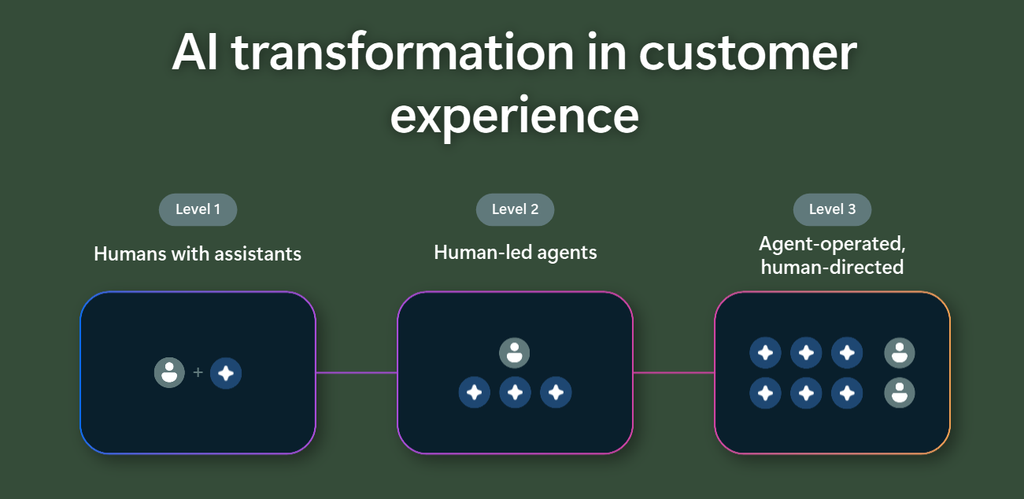
Level 1: Humans with Assistants
This is where most organizations are today.
Copilot helps people:
- Write emails
- Summarize meetings
- Answer questions
- Find information
AI supports work but humans still perform the work.
This is useful and creates productivity gains, but it doesn’t fundamentally change the operating model.
Level 2: Human-Led Agents
This is where things start getting interesting.
Agents are no longer tied to a specific employee and they can operate across systems.
They work across channels.
Between different departments.
And across business hours.
Humans still own the outcome, but AI starts performing parts of the process independently.
We’re already seeing examples of this with agents that identify customer intent, manage knowledge, handle cases, and evaluate service quality. if you want to read more about these agent you can do so in my previous post on Knowledge, Intent, and Evaluation: How Dynamics 365 Is Becoming Agentic
Level 3: Agent-Operated, Human-Directed
This is what I really mean when I talk about Agentic Customer Experience.
The customer experience is largely orchestrated by intelligent agents. Humans provide governance. Oversight, give the strategic direction and support for complex situations.
The role of people changes from doing the work to supervising and improving the system.
That’s a fundamentally different operating model.Humans are now only giving the goals and AI decides which tools to use and how to get to the goal.
This Is Bigger Than Customer Service
Many people assume Agentic Customer Experience is primarily a customer service concept.
But I don’t think that’s true at all.
Customer service is simply where we’re seeing the first visible changes.
What happens when:
- Service agents understand customer intent?
- Sales agents identify opportunities automatically?
- Marketing agents personalize journeys in real time?
- AI continuously learns from every interaction?
At this point, we’re no longer talking about isolated tools but moving the discussion about an entirely new way of managing customer relationships. where human gives the goals and agents do the heavy lifting.
The Real Challenge
Ironically, I don’t believe technology is the biggest challenge.
The biggest challenge is still organizational thinking.
Most companies still ask questions like:
Who owns this process?
Or:
Which department should manage this?
I think we’re moving toward a different question:
What creates the best customer outcome?
That shift sounds small. But it isn’t. Because once customer outcomes become the objective, the traditional boundaries between sales, service, and marketing begin to matter much less.
Final Thoughts
I believe Agentic Customer Experience will become one of the most important shifts in customer engagement since the introduction of CRM itself. Even larger than the time we moved our onprem CRM into the cloud and started automating tasks with Power Automate.
This is not because AI is replacing people. But because AI is changing how work gets done.
For the first time, we can design customer experiences where intelligent systems don’t just support employees.
They actively participate in the relationship.The organizations that succeed won’t necessarily have the best AI.
They’ll be the ones that rethink their operating model around it.Because customers don’t experience your systems.
They experience your company. As one complete unit
And increasingly, that experience will be agentic.