
Dynamics 365 Release Wave 1 2026: Customer Service
Dynamics 365 Customer Service is moving toward a more autonomous, AI-first model. This release focuses on refining the «agentic» capabilities introduced in late 2025—Case Management, Customer Intent, Quality Evaluation, and Knowledge Management—while adding robust oversight tools for supervisors.
The goal for this wave is to move AI from a «chat assistant» to an active orchestrator that can be validated, shadowed, and measured before it is given full autonomy.
For the full release notes see Microsoft Learn
Also you can see my earlier posts for
Sales: https://sjoholt.com/dynamics-365-release-wave-1-2026-sales/
Contact Center: https://sjoholt.com/dynamics-365-release-wave-1-2026-contact-center/
Customer Insights – Journeys: https://sjoholt.com/dynamics-365-release-wave-1-2026-customer-insights-journeys/
Copilot and AI Innovation
Copilot in Customer Service consists of various generative AI capabilities that expedite resolutions of customer issues and increase customer satisfaction.
Simulate case-resolution flows
- What is it? A dedicated simulation environment that allows administrators to test AI-driven resolution logic against historical or synthetic data before it hits the production environment.
- What do we get? Greater reliability. You can «dry run» complex branching logic for both email and chat conversations. This allows you to see exactly how the AI would categorize a case or suggest a resolution, ensuring that automated responses align with your specific business rules and compliance standards.
- Timeline: Public Preview: March 2026 | General Availability: April 2026
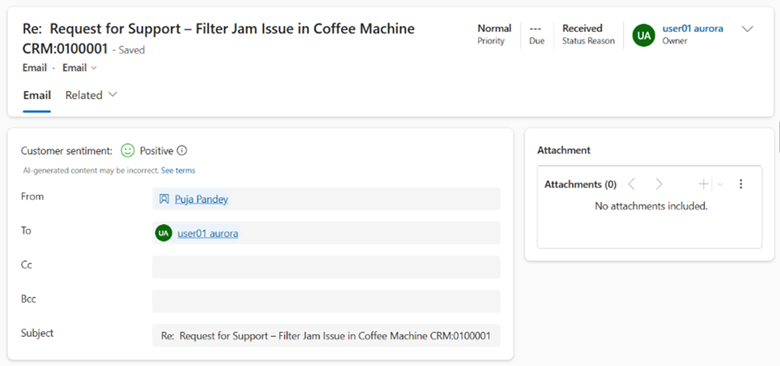
Customer sentiment indicators on cases
- What is it? An embedded sentiment analysis tool that provides a continuous «emotional pulse» of the customer directly on the case form.
- What do we get? Immediate context for the agent. Beyond just a «positive/negative» label, the system identifies shifts in sentiment throughout the interaction history. This allows agents to prioritize escalating frustration and helps supervisors identify which cases might need immediate intervention based on emotional volatility.
- Timeline: Public Preview: March 2026 | General Availability: April 2026
Shadow Mode for Case Management Agent
- What is it? A benchmarking capability where the AI agent runs in the background, making predictions and suggesting actions that are recorded but not executed or shown to the customer.
- What do we get? Data-driven trust. You can compare the AI’s «hidden» predictions (like case categorization or next-best-action) against the actual steps taken by human agents. This «shadowing» period provides a side-by-side accuracy report, giving leadership the confidence to move the AI from background observation to active automation.
- Timeline: Public Preview: March 2026 | General Availability: May 2026
Quality Evaluation: Critical Questions & Adherence
- What is it? An upgrade to the Quality Evaluation Agent that allows for «pass/fail» logic based on mandatory compliance questions and knowledge base adherence.
- What do we get? Automated compliance. You can now define «Critical Questions»—if an agent misses a mandatory legal disclosure or verification step, the AI can trigger an automatic failure for that evaluation. Additionally, the system checks if the agent (human or AI) strictly followed the steps outlined in the official knowledge article linked to the case.
- Timeline: General Availability: April 2026
Evaluation Volume Sampling
- What is it? A management tool to control the scale of automated quality reviews.
- What do we get? Precise oversight without data overload. Instead of evaluating every single interaction, supervisors can configure sampling rules—such as a specific percentage (e.g., 5% of all calls) or an absolute count (e.g., the first 50 cases per day). This ensures you get a statistically relevant view of performance while managing the cost and volume of AI evaluations.
- Timeline: General Availability: April 2026
Supervisor Experiences
Enable supervisors to monitor and improve contact center operations.
AI-driven Dynamic Forecasts
- What is it? A forecasting engine that uses Large Language Models (LLMs) to analyze historical trends, seasonality, and contextual data to select the most accurate mathematical model for your specific data set.
- What do we get? Dynamic staffing precision. Rather than relying on a «one size fits all» forecasting algorithm, the AI detects patterns like sudden spikes or holiday shifts and automatically switches to the best-fitting method. This reduces the time supervisors spend manually tweaking spreadsheets and ensures staffing is always aligned with actual demand.
- Timeline: Public Preview: March 2026 | General Availability: May 2026
Enhanced Screen Recording Controls
- What is it? A native administrative control for capturing the agent’s full screen and system audio during customer interactions.
- What do we get? A secure, integrated training loop. These recordings are stored directly in Dataverse and are linked to the conversation record. Admins can set granular permissions for who can trigger or view recordings, and the system automatically purges local copies to ensure privacy compliance (GDPR/SOC) is maintained.
- Timeline: General Availability: June 2026